
🦾 THE ROBOT RIG REVOLUTION: Is Your CDL Safe? 🚛 Texas’ 2026 Autonomous Explosion! 💥🤠
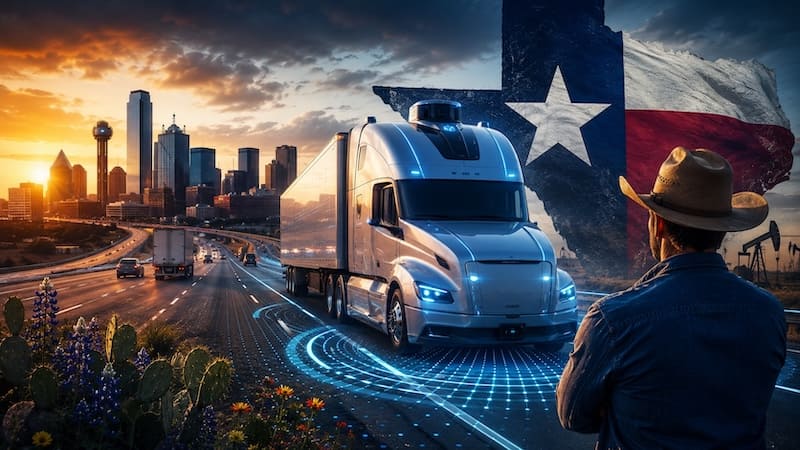
Texas’ 2026 Autonomous Explosion! Welcome to the future. If you’ve driven through the Texas Triangle—the region connecting Dallas-Fort Worth, Houston, and San Antonio—in the last few months, you might have noticed something different. Those rigs with the extra spinning sensors and high-tech cameras aren't just science experiments anymore; they are the new reality of the Lone Star logistics world.
As of mid-2026, Texas has officially cemented its status as the global epicenter for autonomous trucking. With a combination of business-friendly laws (like SB 2205), flat terrain, and a never-ending demand for freight, the state has become the "Silicon Prairie" of the transport world. But what does this mean for the 400,000+ CDL holders in Texas? Is it time to panic, or is it time to adapt? Let’s dive into the technological surge that is reshaping our highways.
🤖 The "Big Three" of Driverless Tech: Who is Dominating the Lanes?
While many states have banned or restricted driverless tests, Texas has rolled out the red carpet. By 2026, the transition from "pilot programs" to "commercial scale" is in full swing.
1. Aurora Innovation: The Scaling Giant
Aurora has moved beyond simple testing. Operating out of their terminals in Dallas and Houston, they are now running fully driverless Class 8 freight with no safety driver in the cab.
- The 2026 Goal: Aurora is on track to expand its fleet from a handful of trucks to approximately 200 autonomous units by the end of this year.
- The 2027 Vision: They expect to scale into the thousands by late 2027, focusing on high-volume lanes like Dallas–Laredo and Fort Worth–El Paso.
2. Kodiak Robotics: The Long-Haul Specialist
Kodiak has taken a staged approach but is hitting massive milestones in 2026. They currently have roughly 10 driverless trucks operating without anyone in the cab, even tackling off-road challenges in the Permian Basin. Their "Atlas" system is designed to handle the 24/7 demands of long-haul trucking, targeting a major on-highway commercial launch in late 2026.
3. Gatik: The "Middle Mile" King
While Aurora and Kodiak fight for the interstates, Gatik has conquered the "middle mile." By 2026, they have completed over 60,000 fully driverless orders on public roads, specifically in the Dallas–Fort Worth region. They specialize in short-haul, repeatable routes for major retailers, proving that the tech works just as well in urban environments as it does on the open road.
💰 The Economic Motivation: Why Fleets are Dumping Humans
It’s a hard truth, but the shift toward autonomous tech is driven by the bottom line. According to industry data, a typical driver’s salary accounts for 26% of the total per-mile cost of operating a commercial truck.
By removing the driver, carriers can:
- Eliminate HOS Restrictions: Robots don't need to sleep 10 hours for every 11 driven. A driverless truck can run 20+ hours a day, effectively doubling the utilization of the asset.
- Increase Fuel Efficiency: AI-driven trucks are programmed for "eco-driving," maintaining steady speeds and minimizing the hard braking that wastes fuel.
- Reduce Insurance Risk: While "nuclear verdicts" remain a fear, AI doesn't get distracted by text messages or suffer from fatigue—two of the leading causes of catastrophic accidents in Texas.
⛽ The 2027 "Price Wall": The Massive EPA Prebuy is Here!
If you think truck prices are high now, wait until next year. A massive Class 8 prebuy is currently underway in late 2026.
The U.S. Environmental Protection Agency (EPA) and California Air Resources Board (CARB) have mandated strict new emissions regulations for the 2027 model year. Experts predict that a new 2027 diesel truck could increase in price by as much as $25,000 per unit due to the complex new exhaust technology required.
The "Prebuy" Strategy
To avoid this $25,000 price spike and the potential reliability issues of first-generation 2027 engines, Texas fleets are loading up on 2026 models. This surge in demand is making it nearly impossible for small owner-operators to find new equipment at reasonable prices.
| Feature | 2026 Model (Current) | 2027 Model (Projected) | Impact |
| Purchase Price | Base + Inflation | +$25,000 surcharge | Heavy Capital Load |
| Emissions Tech | Mature SCR/DPF | Ultra-Low NOx systems | Maintenance Complexity |
| Fuel Parity | Diesel dominant | Closing gap with BEV/Hydrogen | Tech Transition |
| Market Status | High Demand/Prebuy | Low initial adoption | Inventory Stress |
⚡ Beyond Diesel: Hydrogen and the Electric Horizon
As the price of diesel trucks rises, alternative power sources are becoming financially viable for the first time. In 2026, the "cost delta" between a diesel rig and a zero-emission vehicle (ZEV) is shrinking.
Hydrogen Fuel Cells (FCEV)
For Texas, where long distances are the norm, hydrogen is winning over battery-electric for long-haul. Companies like Isuzu and Toyota have partnered to launch hydrogen-powered commercial vehicles that offer fast refueling times comparable to diesel—a critical advantage for high-utilization fleets.
Battery Electric (BEV)
While BEVs struggle with the weight of heavy batteries, they are dominating regional hauling and port drayage in Houston and Laredo. With the 2027 emissions rules making diesel more expensive, many fleets are finding that the lower maintenance costs of electric motors (no oil changes, fewer moving parts) offer a faster Return on Investment (ROI).
🚧 Infrastructure 2026: The $142 Billion Construction "Tax"
Texas is currently in the middle of a record $142 billion Unified Transportation Program (UTP). For the hauler, this means the state is a massive construction zone.
I-35: The Billion-Dollar Bottleneck
The I-35 Capital Express Central project in Austin is the biggest headache for 2026. The corridor currently carries over 200,000 vehicles per day and is projected to hit 300,000 by 2045.
- The Cost of Traffic: Congestion on I-35 alone costs the industry an estimated $761 million annually in lost productivity and wasted fuel.
- Project Milestone: In early 2026, crews are scheduled to demolish the south side of the Martin Luther King Jr. Bridge, leading to massive nightly closures and detours that add hours to delivery windows.
🛡️ Safety vs. Surveillance: The Rise of the AI Dashcam
In 2026, you are never driving alone. AI-enabled dashcams have become a standard requirement for insurance coverage.
Proactive Coaching vs. "Big Brother"
Modern systems like Motive’s AI Dashcam Plus don't just record; they provide real-time voice coaching. If the AI detects signs of drowsiness, cell phone use, or unsafe following distances, it alerts the driver immediately.
- Exoneration: The biggest benefit for the driver is protection against "nuclear verdicts." Video footage in 2026 is the #1 tool for proving a driver was not at fault in a collision, potentially saving fleets millions in legal payouts.
- The Downside: For some, the constant monitoring is a privacy concern, contributing to the 90% turnover rateseen in long-haul trucking as veteran drivers choose to retire rather than be watched.
🏴☠️ The Dark Side of Tech: Cyber-Facilitated Cargo Theft
As fleets get smarter, so do the criminals. Cargo theft increased by 22% going into 2026, with a new focus on Cyber-Facilitated Theft.
Cybercriminals are now using Artificial Intelligence to:
- Manipulate FMCSA Data: Scammers "hack" or spoof motor carrier records to create fake identities.
- Reroute Shipments: By posing as legitimate brokers, they convince drivers to deliver loads to "alternative" warehouses, where the cargo (usually food, energy drinks, or electronics) disappears.
- Identity Fraud: Fraudulent attempts in logistics surged 213% recently, making "Know Your Broker" more than just a catchphrase—it’s a survival skill.
✅ How to Stay Competitive in the 2026 Market
If you are an owner-operator or a small fleet manager in Texas, you can't fight the tech, but you can use it.
- Invest in Telematics Now: Don't wait for a mandate. Use data to find your most profitable lanes and cut out the "deadhead" miles that are currently costing you $2.05 - $2.22 per mile in operating costs.
- Plan for the 2027 Prebuy: If your rig is reaching the end of its life, try to secure a 2026 model before the inventory is completely swallowed by the mega-fleets.
- Check the "Sustained Excellence" Stops: When you need a break from the tech, stop at Toot 'n Totum #105 in Stratford, TX. It was voted the #1 truck stop in the U.S. for 2026 for a reason: it still values the human element of trucking.
- Bilingual Capabilities: With the FMCSA doubling down on English Proficiency and the rise of cross-border trade in Laredo, being able to navigate both languages and cultures is a massive competitive advantage in 2026.
🔮 Conclusion: The Hybrid Future
The "Robot Revolution" doesn't mean the end of human drivers—at least not yet. For the foreseeable future, we are entering a Hybrid Era. Robots will handle the long, boring stretches of I-10 and I-20, while humans will be needed for "first and last mile" urban navigation, securing specialized loads, and managing complex border documentation.
Texas trucking in 2026 is faster, more expensive, and more digital than ever before. Those who embrace the data, watch the 2027 price walls, and stay compliant will be the ones still hauling when the dust from the I-35 construction finally settles.